One of the reasons why Burnout Recovery includes a chapter on Neurodivergent burnout is because many Millennials and Gen Xers who are currently navigating various stages of burnout are also undiagnosed neurodivergent folks.
I personally discovered my autism in the midst of traditional burnout, which is not an unusual circumstance. Many neurodivergent adults only discover this about ourselves when we lose the ability to “fake” being neurotypical anymore.
Signs that this may be relevant to you are:
- Burnout is harder to bounce back from, and takes longer to recover
- Increased outbursts of anger or frustration
- Feeling “stupid” or like things that used to come easily no longer do
- Heightened sensitivity to sensory stimuli
I’m going to break down the differences between the two kinds of burnout and how you can determine whether you are experiencing one or the other.
Neurodivergence Vocabulary
The term “neurodivergent” arose in the early 2000s from online communities of adults who were collectively realizing they had similar experiences of the world. Activist Kassiane Asasumasu is credited as the person who came up with the word, intending it to be an umbrella term for any sort of difference in sensory and cognitive experience. This includes (but is not limited to) ADHD, autism, epilepsy, apraxia, dyslexia, dyspraxia, synesthesia, and a host of other conditions. Later iterations of the terminology came to include “neuroptypical” for those who do not have sensory and neurological differences, and “neurospicy” which is a playful way to suggest an unknown mélange of these difference.
These terms are from within the neurodivergent community, and not specifically medical or psychological.
It might seem like a lot of people are “suddenly” autistic or ADHD (or the combination of the two, commonly referred to as AuDHD). This is partially because there is greater awareness of the signs and clearer diagnostic criteria for the conditions. When I was kid, my autism wasn’t “a thing” because I was not a boy, I didn’t have problems at school, and I had good grades. In my own social spheres, many Gen X adults are getting diagnosed late in life because their children have been diagnosed. Unfortunately, the other late-diagnosed adults I’ve met have obtained this information late in life because of burnout.
You don’t need to be professionally diagnosed to benefit from learning about neurodiversity. Self-diagnosis is valid, and getting diagnosed is expensive and difficult. There are self-assessments online. The RAADS-R is particularly good for those of us who might have slipped through the normal diagnostic criteria. There are multiple websites offering the RAADS-R for free.
How Can I Tell The Difference Between Neurodivergent Burnout and Typical Burnout?
Below is a diagram that differentiates typical burnout from depression and from neurodivergent burnout. In all cases, there’s a sense of hopelessness and helplessness, so it’s important to talk to others about this and get support.
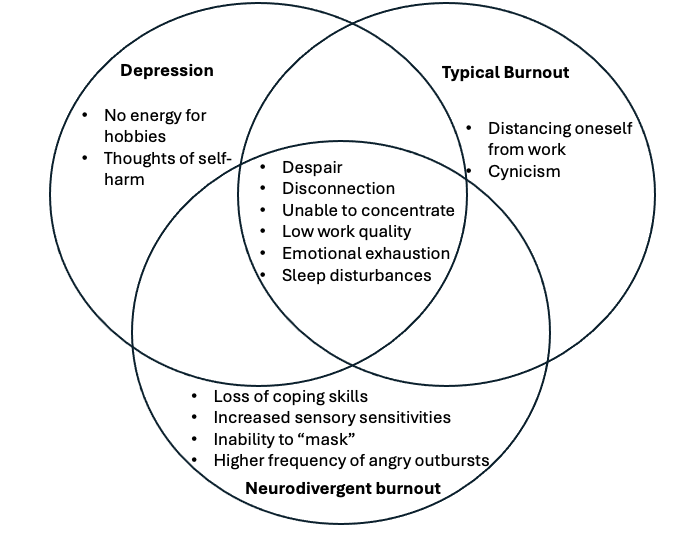
What you’ll notice is that depression is far-reaching. It extends into hobbies and home life where typical burnout does not. Neurodivergent burnout often extends into home life as well. In particular, coming home exhausted after the workday and needing to be in silence or in the dark in order to recover can be a sign that neurodivergent burnout is at play.
The inability to “mask” is another big sign that neurodivergent burnout is looming. “Masking” is a conscious, effortful, energy-draining task of performing neurotypical actions in social contexts. For example, if you find eye contact uncomfortable, but consciously choose to make eye contact in social situations, that might be a form of masking. I discovered I have a masking-specific form of laughter that I would use to defuse situations that were uncomfortable for me.
Do I have Both Neurodivergent and Professional Burnout?
It is perhaps the most common case for undiagnosed neurodivergent adults to have both forms of burnout at the same time. This is because the professional burnout and increased stress levels can lead to the neurodivergent burnout.
For example, while the overhead fluorescent lights and the constant distraction of interruption and noise at the cubicle farm didn’t bother me when I was operating at normal levels of stress, when I started getting super burned out, those became intolerable to me. These two kinds of burnout exacerbate one another. Being overwhelmed by the sensory experience of the office made my stress levels higher with workload pressure, and so on.
How can I Recover from Neurodivergent Burnout?
Typical professional burnout typically takes 1-2 years to fully recover from. The timelines that I’ve seen for neurodivergent burnout are usually in the 3-5 year timeframe. It’s going to take a long time.
To a certain extent, you may be permanently changed by neurodivergent burnout. You may find your ability to mask is forever decreased after this point. You may find that you have sensory sensitivities that never go away. However, there is a path and roadmap to recovery.
Learning the self-supports and support needs that you have from others can be a critical way to help yourself during this process. By learning how to articulate your needs, you could potentially request accommodations at school or work.
Examples of accommodations might include:
- Extra time to complete projects
- Being able to work from home where you can control sensory input
- Clarity on meeting agendas so you can prepare in advance
- Closed captions on zoom enabled, or meeting / lecture notes provided
- Dedicated quiet work blocks so you can concentrate on projects
- Different working hours so you can have time with fewer interruptions
Chapter three of the book, Burnout Recovery includes a large number of ways to support yourself and discover your support needs. It also provides a metaphor for recovery that might help you in this journey.